
Reduce the policy-related costs included in your business electricity prices.
Bonham & Brook will assess your eligibility and manage your EII Exemption application through to the exemption being applied to the relevant electricity charges.
.jpg?width=719&height=815&name=1%20(3).jpg)

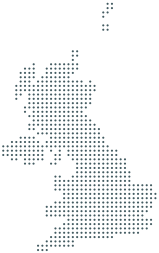
EII Exemption is available to manufacturers in Great Britain that meet the scheme’s product, activity and electricity intensity requirements:


Business must manufacture at least one product covered by an eligible product code.
.svg)
Manufacturing activity must fall within an eligible four-digit NACE code.

The eligible product must be manufactured at a site in Great Britain.

Business must have an electricity intensity of at least 20% under the business-level test.

The sector-level test checks whether the product and manufacturing activity are eligible. The business-level test compares representative electricity costs with the business’s Gross Value Added (GVA).
The EII Exemption Scheme covers specific activities within the following industry areas:
At least one product manufactured by the business must fall within an eligible four-digit NACE code. The proportion of electricity used for eligible manufacturing determines the percentage exemption granted.
A confirmed match between the product, manufacturing activity and NACE code satisfies the sector-level test. The business-level test is assessed separately.
Mining & Quarrying:
Food & Beverage:
Textiles:
Leather:
Wood & Paper:
Chemicals, Refining & Plastics:
Glass & Ceramics:
Building Materials & Minerals:
Metals:
Metal Packaging & Electronics:

An EII exemption application requires more than confirming that your business meets the basic eligibility criteria. It must demonstrate that your manufacturing activities and products match eligible NACE codes. It must also establish your electricity intensity under the business level test, and calculate the eligible electricity share at each meter or supply point. Complex production arrangements, shared supplies and mixed eligible and ineligible products all affect the outcome.
Our compliance guarantee: Our energy specialists establish a clear, defensible basis for your application. We verify your sector and product eligibility, calculate your business level test accurately, and determine your eligible electricity share before submission.

Reduce your electricity costs under the EII Exemption Scheme. Eligible manufacturers could save up to 20% on their representative electricity bill through exemptions on CfD, RO, FiT and CM charges.
We manage the full EII application process, from initial assessment through to submission within the DBT deadline and supplier implementation.
EII Eligibility AssessmentWe confirm whether your products and manufacturing activities meet the scheme criteria
We estimate the potential EII saving across your manufacturing before you decide to proceed with a full application. The exemption value depends on your eligible electricity share and the level of qualifying charges.

We assess how mixed production, shared supplies and multiple meters affect your eligible electricity share and exemption value.
Our structured approach identifies whether your business meets EII eligibility requirements, establishes your electricity intensity and eligible electricity share, and prepares a compliant application for submission to the Department for Business and Trade.

New businesses can apply for an EII Exemption Certificate before they have a full year of accounts. A business trading for fewer than 21 months can apply with at least one quarter of financial information and production and electricity data.
Speak with our specialist to discuss whether your new business is eligible and what records you'll need to prepare.
Your EII Exemption engagement is led by a team of dedicated Energy Tax Relief Specialists.
The same specialist remains responsible for your work from the initial review through to supplier implementation and beyond. You have one direct point of contact for questions, information requests and application updates.

Mohamed, an Engineering graduate, started in facilities management, collaborating with energy and sustainability experts. He became an Energy Manager at a large biomedical research facility, overseeing one of the largest inner city renewables installations in the UK. Transitioning to financial consu...


Associate Director - Head of Energy

Njomza holds a Geography degree from King’s College London and was instantly interested in the energy sector upon graduating. She now works at Bonham and Brook in the Energy department, where she assists clients in identifying and claiming incentives related to reducing their energy costs. An Energy...
Energy Consultant

After graduating with a Natural Sciences degree, Muntasir joined Bonham and Brook as an Associate Energy Consultant. Having specialised in Physics, his strengths lie in independent research, programming, and data analysis. Muntasir is continuously learning from more experienced colleagues and from t...
Energy Consultant
Discover how Bonham & Brook supported leading UK food manufacturer Weetabix secure valuable Energy tax relief.
Book a structured, no-obligation review with a specialist. We'll assess your manufacturing activities and provide a clear eligibility recommendation.

All discussions are held in strict confidence.

Initial eligibility consultation is always complimentary.

.svg)


