How successive Budgets are reshaping the balance between retrospective tax relief and incentives for new investment
The capital allowances changes announced in the Autumn Budget 2026 continue a trend that has been building over the last decade.
Capital allowances have long played an important role in encouraging investment, by providing a valuable mechanism for businesses to indirectly reduce the cost of commercial assets through tax relief. However, the landscape is continually changing.
Successive Budgets have progressively reshaped the regime, with reductions in traditional Writing Down Allowances being accompanied by increasingly generous incentives designed to accelerate relief on new investment.
This raises important questions about the government's long-term intentions, the practical value of the latest incentives and, perhaps most importantly, what these changes mean for businesses seeking to maximise their tax relief.
Looking beyond the headline announcements, it is worth considering how we have arrived at this position and why the timing of capital allowances claims is becoming more important than ever.
Capital allowances changes in the Autumn Budget 2026
he Autumn Budget 2026 delivered relatively few significant surprises for the capital allowances regime. However, beneath what might initially appear to be relatively modest announcements lies a continuing shift in the government's approach to tax relief on capital investment.
The Chancellor announced two key changes:
- Main Rate of Writing Down Allowances (WDA) - a further cut, decreasing the rate from 14% to 12% from April 2027. This follows the previous reduction from 18% to 14% in April 2026, representing a 33% reduction over just two years, after fourteen years of consistency.
- Main Rate First Year Allowance (FYA) - an increase, rising from 40% to 50% from January 2027.
By reducing the rate at which businesses can obtain relief on existing capital expenditure, whilst simultaneously encouraging investment through more generous upfront tax incentives, these measures, taken together, reinforce an increasingly apparent direction of travel.
But what do these changes mean for businesses, and are the incentives being introduced sufficient to offset the diminishing value of traditional capital allowances?
The impact of lower writing down allowances
A reduction in the Main Rate WDA from 14% to 12% may, on the face of it, appear relatively insignificant. However, when considered alongside the reductions introduced over recent years, the cumulative impact becomes considerably more apparent.
To illustrate this, consider a business with an existing Main Rate Pool of £1 million. The following comparison demonstrates how long it takes to obtain relief on the expenditure under the previous and current rates of WDA.
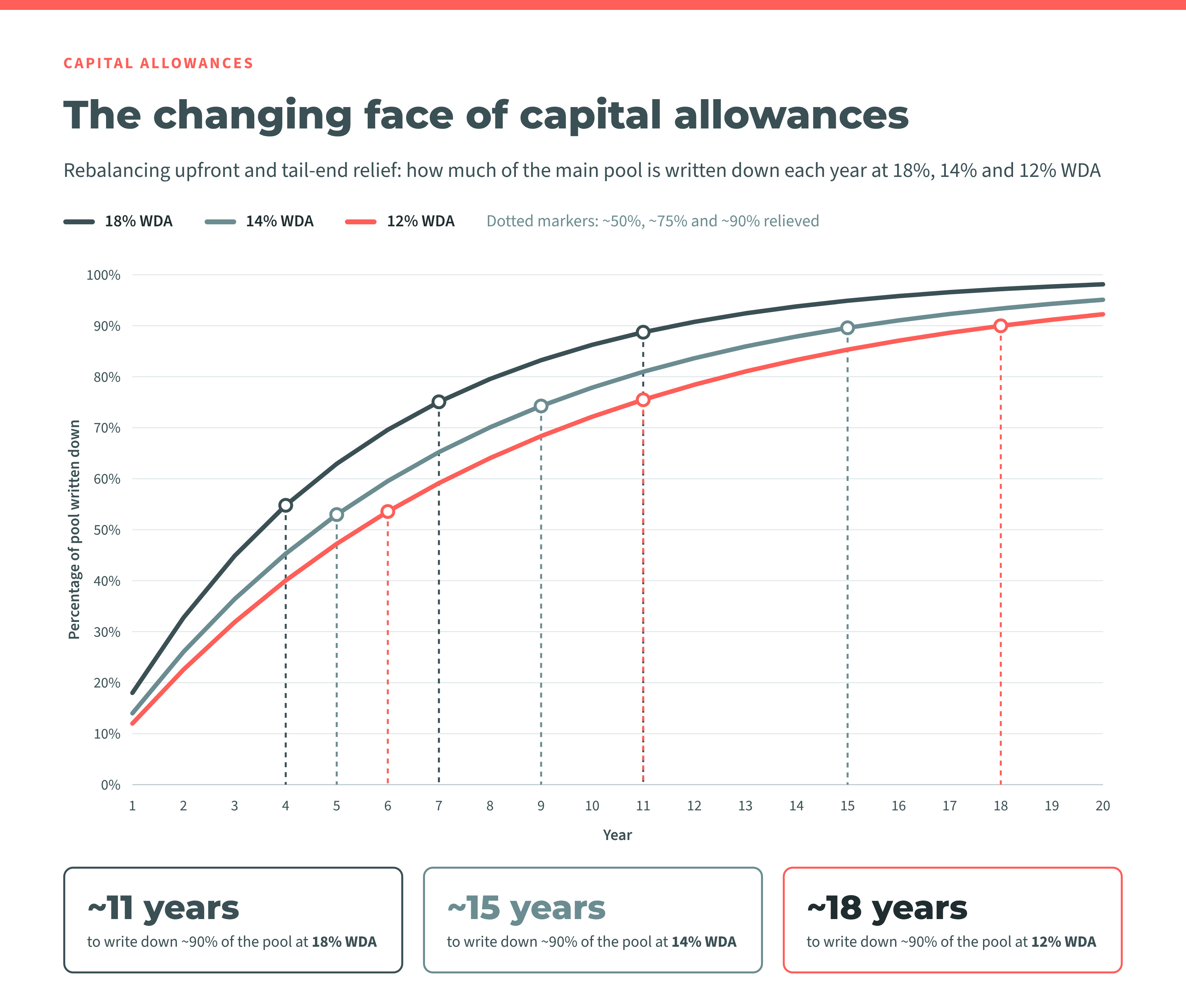
The figures demonstrate a considerable change in the timescale over which businesses can obtain tax relief.
Under the former 18% rate, it would take approximately four years to obtain relief on at least half of the original pool value. At the new 12% rate, this increases to approximately six years. 50% longer.
For a company subject to the main rate of Corporation Tax, this represents an approximate £40,000 reduction in tax relief obtained over the first six years when compared with the former 18% rate, assuming the full pool remains available and ignoring other changes in the company's tax position.
The longer-term picture is equally significant. After 11 years, almost 90% of the original pool would have been relieved under the former 18% rate. Under the new 12% rate, this falls to 75%.
In other words, businesses are having to wait considerably longer to obtain the same level of tax relief, with more expenditure remaining within the capital allowances pools for longer.
Does the 50% first year allowance really help?
Some may argue that these reductions are being offset by the increase in the Main Rate FYA. However, when we consider which businesses can actually benefit from this incentive, the picture becomes less straightforward.
The 50% Main Rate FYA is available to both incorporated and unincorporated businesses on qualifying new and unused Main Rate plant and machinery. Importantly, unlike Full Expensing, it can also apply to qualifying assets acquired for leasing.
Here is how it competes with the other first year reliefs:
- Companies (Corporation Tax) - Full Expensing already provides 100% first-year relief on qualifying new and unused Main Rate plant and machinery, although it remains relevant in circumstances where Full Expensing is unavailable, including certain leasing arrangements.
- Unincorporated businesses (Income Tax) - Sole traders, partnerships and LLPs, cannot access Full Expensing. However, they can benefit from the Annual Investment Allowance (AIA), which currently provides 100% first-year relief on up to £1 million of qualifying plant and machinery expenditure per annum.
This raises an interesting question. How many unincorporated businesses are regularly exceeding the £1 million AIA threshold and subsequently requiring the additional 50% FYA?
There will undoubtedly be businesses that benefit, particularly those undertaking substantial capital investment or operating within sectors with significant expenditure requirements. Nevertheless, the number is likely to be relatively limited when compared with the wider business population.
The question, therefore, is whether the increase in the Main Rate FYA represents a genuinely significant improvement in the availability of tax relief, or whether its practical benefits are more narrowly concentrated than the headline announcement might suggest.
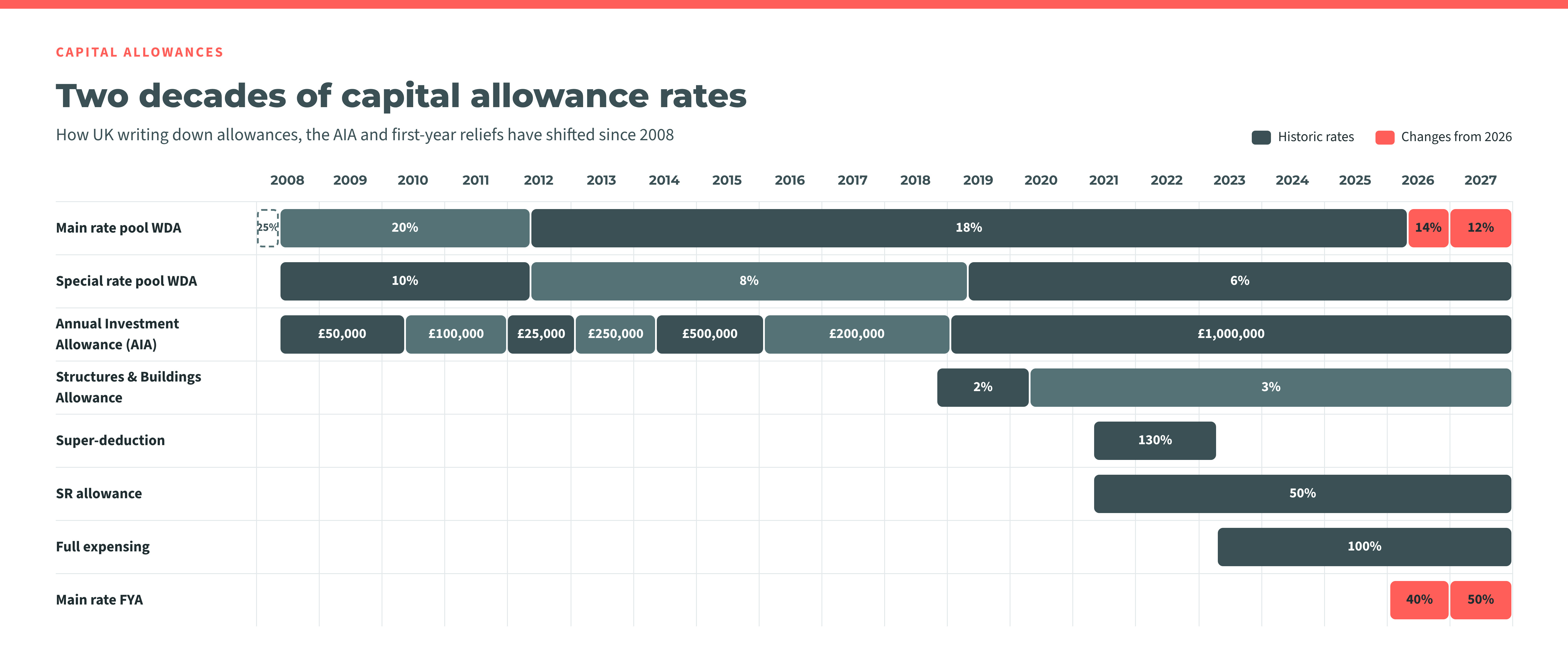
The evolution of UK capital allowances since 2008
To understand the significance of the latest changes, it is worth considering how the capital allowances regime has evolved over the last 18 years.
The direction of travel becomes considerably clearer when the key legislative changes are comparatively observed, as illustrated below:
Viewed collectively, these changes demonstrate how substantially the capital allowances landscape has evolved. The emphasis has progressively shifted away from the rate at which businesses can obtain relief over time and towards the availability of accelerated relief at the point of investment.
What the capital allowances changes mean for businesses
When considering the evolution of capital allowances over the last 18 years, a clear distinction emerges between the treatment of existing capital expenditure and the incentives available for new investment.
On one hand, the opportunity to obtain tax relief through traditional Writing Down Allowances is diminishing. On the other, the incentives available to businesses investing in new plant and machinery, constructing new properties or undertaking qualifying improvements and renovations are becoming increasingly attractive.
This is not simply a coincidence.
By reducing the rates of WDA, the government can manage the ongoing cost of capital allowances to the Exchequer, whilst encouraging businesses to invest through more generous upfront tax incentives.
In effect, the emphasis is moving towards rewarding investment rather than simply providing an ongoing mechanism for obtaining tax relief on historical expenditure.
Arguably, the fundamental purpose of capital allowances has always been to encourage business investment, improve productivity and support economic growth. Historically, however, businesses had considerably more scope to obtain relief retrospectively, whether on new plant and machinery or on second-hand assets acquired as part of a commercial property transaction.
That position is changing.
The legislative requirements surrounding fixtures, particularly the pooling and fixed value provisions, have already restricted the ability to establish and claim allowances following a property acquisition where the necessary steps have not been taken.
As we move further away from the introduction of these requirements, the number of opportunities to recover previously unclaimed allowances on second-hand fixtures will inevitably diminish.
There is also an increasing risk that businesses undertaking construction and renovation projects will miss out on valuable first-year incentives because capital allowances assessments are not undertaken at the appropriate time.
In an environment where tax relief is increasingly weighted towards the point of investment, the timing of a capital allowances assessment is becoming just as important as the identification of qualifying expenditure itself.
Example: a new care home build
A company constructs a new care home at a total cost of £5 million. A capital allowances review identifies £1 million of qualifying expenditure eligible for Plant and Machinery Allowances.
- Prompt assessment - By claiming the available reliefs in the year the expenditure is incurred, the company maximises its tax savings through Full Expensing and the Annual Investment Allowance (AIA), generating an immediate tax saving of approximately £250,000.
- Delayed assessment - However, if the company delayed its claim, the opportunity to benefit from these enhanced first-year allowances may be lost, potentially reducing the initial tax saving to approximately £20,000 through the current writing down allowance regime.
Don't wait to claim what you're entitled to
The direction of travel is clear. The capital allowances regime is increasingly rewarding businesses that identify and maximise their tax relief opportunities at the point of investment, rather than those attempting to recover missed opportunities retrospectively.
For businesses that have recently undertaken, are currently undertaking, or are planning construction, refurbishment or renovation projects, capital allowances should form part of the wider financial and tax planning process from the outset.
The potential benefits can be substantial, but identifying qualifying expenditure is only part of the exercise. Understanding which allowances are available, the conditions attached to them and the relevant deadlines is essential to ensuring that the available relief is secured and utilised as efficiently as possible.
Capital allowances should not be viewed as an afterthought once a project has been completed or a property has been acquired. They should be considered an integral part of the investment process.
The opportunity to maximise tax relief is there, but the window in which to take advantage of the most generous incentives is becoming increasingly important.
This is not to suggest that retrospective reviews should be disregarded or that property acquisitions no longer present opportunities to generate valuable tax savings. Rather, these opportunities require greater consideration.
Don't wait until the project is complete.
Don't wait until the accounts have been prepared.
Don't assume that the opportunity to claim will always be there in the future.
Engaging a capital allowances specialist at the appropriate stage can make a material difference to the tax savings ultimately achieved. If you are considering a property acquisition, planning a construction or renovation project, or have historical expenditure that has never been reviewed, contact Bonham & Brook to discuss the available relief with us and your accountant.
 27/11/2026

 Back





 20/10/2026
 Chris-Howell Jones